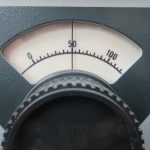
Here is a quick post regarding my Heathkit HW-8 CW Transceiver at N6CC. They were first sold in 1976 for around $140. I built this kit about 50 years ago and it still works great.
($140 in 1976 dollars = about $822 in 2026. Thank you inflation!)
“Learn by Doing”. Heathkit’s catch phrase. Indeed. I miss them.
It is a very satisfying radio to operate, very intuitive, simple and fun. NO unobtanium micro processors, multiplexed function buttons, LCD displays waiting to fail, menus or memories. Just the good kind of memories.
These were available in the late 1970’s as an upgrade to the HW-7, a similar kit but it had its problems, resolved with the HW-8. It is kind of a “Swiss Army Knife” for simple low power QRP operation with its stable analog VFO and multiband coverage of 80-15 meters. Mine produces about 3 watts into 50 Ω on 40 meters with 13.4 VDC input. Plenty sufficient with a good antenna for reliable comm sessions from home or in the woods.
The transmitter is full break-in QSK, excellent keying dynamics, pleasant sidetone and I can’t hear the T/R relay.
As a “woods radio” it can’t compete with new modern stuff in terms of volume or weight. Pocket sized HF transceivers and lightweight batteries are great for POTA/SOTA ops but my knees are past that for hiking up the hills. For tailgate camping this little set with a simple SLA battery works great for my purposes. A lot has changed in the past 50 years!

The HW-8 uses a simple Direct Conversion receiver that is very easy to listen to for long operating periods. Some call DC receiver sound as “transparent”. I’d call it “natural”. It has none of the constrained-sounding artifacts of today’s hi tech radios with their phase noise, DSP hash, distortion products, ringing etc. It can be overloaded by strong signals.
Not to overthink this little rig but a quick sensitivity test on 7050 kc was in order: It can produce usable audio from a 0.2 microvolt signal on 40 meters but that’s about the noise floor. A 1 microvolt signal is clearly above the noise. About 6 microvolts drives the meter to half-scale. Good to know. The preselector, RF stage and RF Gain control help considerably.
The Wide-Narrow audio filter is effective for my casual operating, purists might groan.
As many other owners have noted this little set works great as-is but is also easily modified to improve its usability (50 years later!). The 1991 HW-8 Handbook by Michael Bryce, WB8VGE is a primary reference; there are many other resources online for these sets.
The Dreaded Ham-mering: I generally don’t like to make, or need, modifications to good equipment. However a few simple ones make sense here. I’m not trying to replicate a modern, do-everything wonder, those are actually not very interesting to me.
I have added an internal speaker to simplify field ops, driven by a TDA 2002 AF amplifier IC. (It’s overkill here but it’s what I had, an LM386 would work just as well.) An added 100 kc crystal calibrator is handy although the dial tracking is otherwise very good. Incandescent lamps illuminate the tuning dial and the panel meter for night ops. (non-red LED’s were hard to find and expensive back then!). I like the old-timey warm glow.
The AF amplifier/speaker driver, crystal calibrator, voltage regulator and the incandescent lamps do increase the power consumption however. Since I usually use it with a big 8AH SLA battery while portable the operational price for those mods is minimal. The specified current draw at 13.4 volts is 90 ma RX, 430 ma TX in stock configuration. With these mods “on” the current increases by around 35 ma.

I added an internal LM317 voltage regulator circuit and reverse-polarity protection. The regulator is to enable use with >>12 volt “wall wart” DC power supplies. Those can actually be well above 12 volts with this light load. The one I use with the HW-8 and some other equipment on AC is this one, rated at 15 VDC @ 800 ma. Under the HW-8 load it rises to 19 VDC, too much in either case. The LM317 handles it providing 13.4 volts under load.

Stable 12 volt sources such as a battery are wired to bypass the regulator via one of the 4 pins in the connector as marked. I also incorporated an internal fuse as part of the reverse-polarity protection. Modifications I incorporated include the 4-pin MS/Burndy power connector to make it compatible with my home and field solar power distribution systems. This replaces the original Molex type. Here’s the rear panel, no insults to the front panel.

I added a BNC and an SO-239 antenna connector, each in parallel with the RCA phono jack for field antenna flexibility.
I also added an SPST push button test key in parallel with the Key jack. This to facilitate tuning when I may not have a key readily accessible during setup. It can also be an “emergency” key in case you forgot the J-45. The toggle switch turns the panel lamps and the 100 kc calibrator on/off.
I had previously added clips on the left side panel for 8 AA cells to power it internally as a simplification in the field to make it more self-sufficient (since removed). There is lots of room in here for further mods if desired. There is already a lot going on inside this radio, see below. I still need to add a bunch of zip-ties!

Another handy mod was to incorporate an audio-level capability to the panel meter which originally was used for a power-output indication only. It was/is not a calibrated “S” meter to indicate signal strength in today’s sense. Now it indicates signal “loudness” (upstream of the volume control) in addition to relative power output on transmit. Close enough, it gives real “life” to the receiver in operation.

Now off to the Field again! I set up a small carrying case, formerly employed as a transit case for PVS-7 Night Vision Goggles. A perfect size for this kit which includes the radio, 12 Volt SLA battery, DMM, electronic keyer, DIY Hacksaw blade knee paddle. It also includes an EFHW antenna with 49:1 Z impedance transformer as seen here. I also have a dipole kit with feedline from the PRC-74 system available.
Along with my little 12 volt solar panel I am ready and able for indefinite operation from the field.

Below is the kit in operation during Winter Field Day 2026 on cold and very windy 3-day camping trip to Mt. Diablo CA.
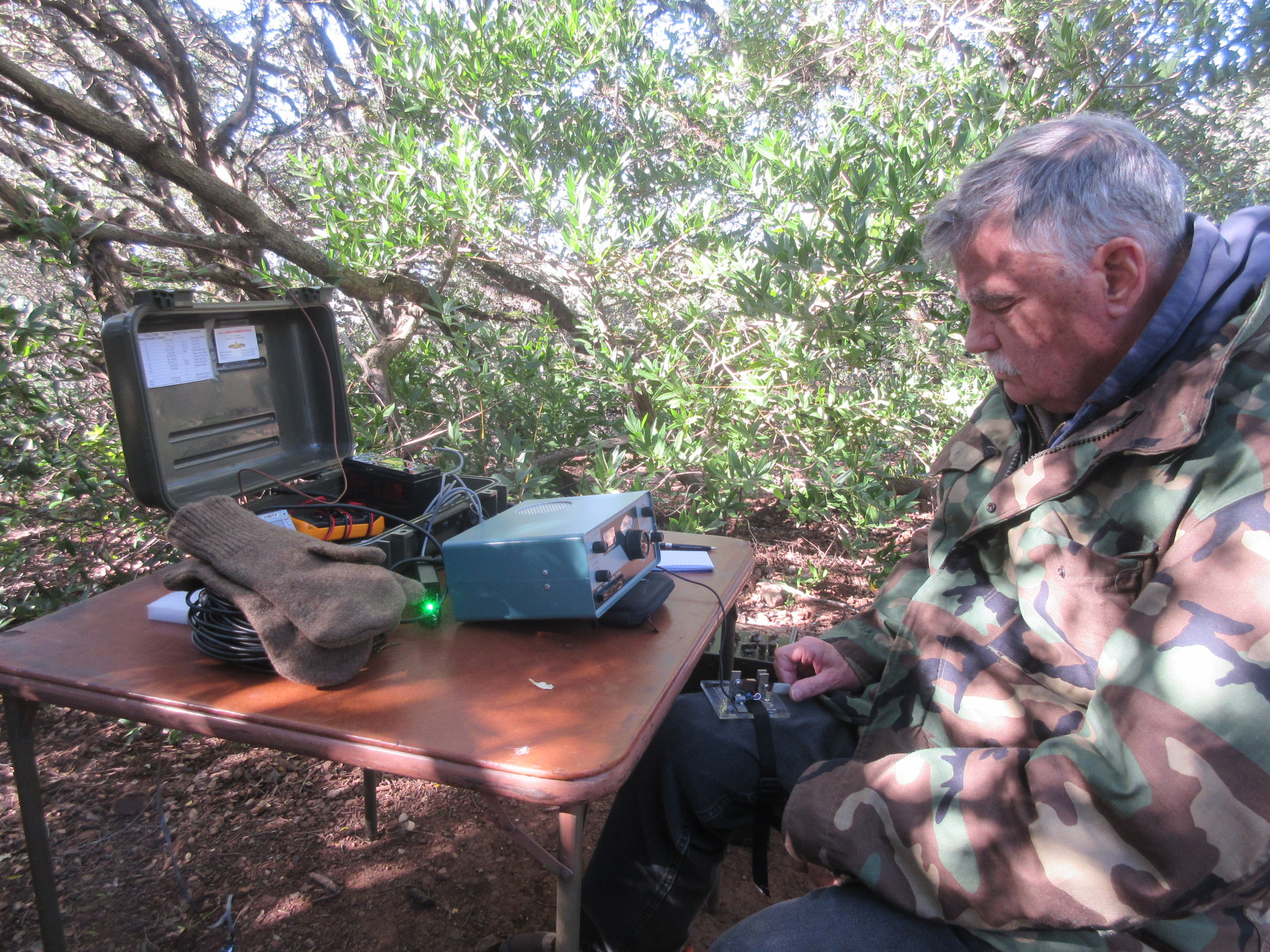
Another shot with its military companions, the PRC-174 CW/AM/SSB manpack set and the TRC-77 HF CW portable set.

As with any of my CW field sets it works great being operated by a J-45 “Knee Key” clamped to my leg (which then eventually turns blue). However for long operational periods I use a little “MX-K2” electronic keyer controlled by my DIY “hacksaw blade” key strapped to my leg.

A very simple, lightweight, bomb-proof keyer paddle, not easily damaged during transport or abuse at a field site. A scrap of plexiglass, angle brackets a few machine screws, defunct hacksaw blade and a nylon buckle strap makes it happen. I also included 4 rubber feet and a 1/4″ chunk of lead plate to hold it down while working on a desk surface. Very effective.

I don’t have any photos from much earlier camping trips with the HW-8, back in the “film camera” millennium. HiHi.
Does the HW-8 work well in the field? Yes. Some actual signal strength measurements as recorded.
Below is a tabulation of my HW-8 Spots on 80, 40, 20 and 15 meters from the Reverse Beacon Network while camping last weekend. (The first 2 Spots by W1NT/6 are false, not me). This little 3 watt rig with a rather poor end-fed, low wire antenna gets out pretty well!
| ● spotter | ● spotted | distance mi | freq | mode | type | snr | speed | time | seen |
|---|---|---|---|---|---|---|---|---|---|
 W1NT-6 W1NT-6 | N6CC | 2664 mi | 3521.5 | CW | CQ | 12 dB | 24 wpm | 0459z 25 Jan | 5 days ago |
| W1NT-6 | N6CC | 2664 mi | 3527.5 | CW | CQ | 4 dB | 24 wpm | 0239z 25 Jan | 6 days ago |
| W6YX | N6CC | 29 mi | 7045.0 | CW | CQ | 28 dB | 17 wpm | 2048z 24 Jan | 6 days ago |
| K2PO/7 | N6CC | 527 mi | 7046.1 | CW | CQ | 7 dB | 16 wpm | 2047z 24 Jan | 6 days ago |
| W6YX | N6CC | 29 mi | 7046.1 | CW | CQ | 28 dB | 16 wpm | 2047z 24 Jan | 6 days ago |
 VE7CC VE7CC | N6CC | 789 mi | 21044.9 | CW | CQ | 7 dB | 15 wpm | 2040z 24 Jan | 6 days ago |
| VE7CC | N6CC | 789 mi | 21044.9 | CW | CQ | 7 dB | 15 wpm | 2040z 24 Jan | 6 days ago |
| KW7MM-3 | N6CC | 719 mi | 21044.9 | CW | CQ | 14 dB | 16 wpm | 2040z 24 Jan | 6 days ago |
| KW7MM-2 | N6CC | 716 mi | 21044.9 | CW | CQ | 16 dB | 16 wpm | 2040z 24 Jan | 6 days ago |
| KW7MM | N6CC | 719 mi | 21044.9 | CW | CQ | 15 dB | 16 wpm | 2040z 24 Jan | 6 days ago |
| W6YX | N6CC | 29 mi | 21044.9 | CW | CQ | 23 dB | 16 wpm | 2040z 24 Jan | 6 days ago |
| W6YX | N6CC | 29 mi | 14057.9 | CW | CQ | 22 dB | 16 wpm | 2038z 24 Jan | 6 days ago |
| K2PO/7 | N6CC | 527 mi | 14057.9 | CW | CQ | 17 dB | 16 wpm | 2038z 24 Jan | 6 days ago |
| WA7LNW | N6CC | 468 mi | 14057.8 | CW | CQ | 9 dB | 16 wpm | 2038z 24 Jan | 6 days ago |
| W6YX | N6CC | 29 mi | 7046.1 | CW | CQ | 28 dB | 16 wpm | 2036z 24 Jan | 6 days ago |
| K2PO/7 | N6CC | 527 mi | 7046.1 | CW | CQ | 5 dB | 16 wpm | 2036z 24 Jan | 6 days ago |
| KW7MM-2 | N6CC | 716 mi | 7050.0 | CW | CQ | 22 dB | 18 wpm | 0203z 23 Jan | 8 days ago |
Many signal reports were from 700+ miles with very good SNR as received.
Take a look here for my recent Field Op which included the HW-8 producing the above Spots:
https://www.n6cc.com/winter-field-day-2026-with-military-radios/
Stay tuned for further field adventures!
AR
NNNN