
UPDATED 8/5/2025
Radioactive Radios! Like old wrist watches and clocks with “glow in the dark” hands and numerals, some radium painted meters and instruments had radioactive paint on their needles and scales. A radium-containing compound was mixed with a binder and phosphorescent material that emitted visible light without the need to “charge” the paint with an external light source.
This use of radium for night illumination was common during WWII and up into the late 1960’s.
I remember that when I was a kid I looked at my fathers wristwatch hands under a low power microscope. In the dark, you could see the individual flashes of light emitted from the paint as an Alpha particle slammed into a phosphor crystal. Scintillating! Somehow I survived my childhood.
In this case, the alpha particles (Helium nuclei) emitted by the decaying radium 226 bombarded the phosphorescent material to ionize the photoemissive material. This process converted the alpha particles’ energy into visible light. For a long time. The phosphor material was typically Zinc Sulfide crystals.

The meter shown above has radium paint on the needle and the 3 scale lines. This paint is usually a pale yellow to light brown color from the ones I have seen. This particular meter emits 0.5 mR/hr at the glass window, about 50 times the normally low background of 0.01 mR/h in this area.
My local background radiation level measurement of 0.01 mR/hr was made with a GQ Electronics GMC-800 Geiger counter “survey” meter. It cannot detect alpha radiation. Some sensitivity specifications:
Range of dose rate indications, μSv/h 0.00 to 2000
Range of exposure dose rate indications,mRem/h 0.00 to 200
Range of registered beta radiation energy 0.25 to 3.5 MeV
Range of gamma radiation energy, 0.1 to 1.25 MeV
Range of registered X-ray radiation energy 0.03 to 3.0 MeV
Any radiation decreases exponentially with distance from the source due to the Inverse Square rule. I=1/d^2. Doubling the distance reduces the radiation by a factor of 2^2 =4. Tripling the distance reduces the radiation by 2^3 = 8. Etc. So with very close range detections like the these the actual measurement is very sensitive to the distance from the source to the detector.
Now 80 years post-WWII the radium continues to exponentially decay (to radon gas which is also radioactive). So 80 years later there is still around 89% of the original radium still present.
Not a lot of granite, phosphates or bananas around here near sea level – my local, natural background:

Another common radioactive material: Older lantern mantles had Thorium in them. It included an unstable, naturally-occurring radioactive isotope Th 232 as well. Thorium oxide has a very high melting temperature and emits a very bright white light when heated by the burning lantern fuel. When Coleman stopped selling the Thorium mantles, circa 1990, the replacement product apparently used Yttrium instead. I had both types; the newer mantles put out about 60% of the light the Thorium mantles do. The old – style Thorium mantles were routinely used by health-safety personnel as “check sources” to verify the proper basic operation of Geiger counters. They can typically measure up to about 0.10 mR/hr, about 10 times background at close range)
Below: The meter in my SCR-284 is relatively “hot” radioactivity-wise. Probably because there is a relatively large amount of radium-mix paint on the scale.
Here is a measurement made with the GMC-800 Geiger counter at near-zero distance from the paint. It is about 80 times higher than my local background:

The front panel Channel Number indicators adjacent to the push buttons on my BC-683 Artillery Band receiver also contains radioactive paint.
Below: That receiver shows around 5.46 mR/Hr when the detector is touching the panel. This is mostly gamma radiation as shown on the GQ GMC-800 Geiger Counter. That device cannot detect the alpha radiation emitted by radium 226 decay but it can detect the gamma radiation also emitted. It’s pretty “hot” at zero distance, more so than any other device that I have. It falls back to background levels (around 0.01 mR/Hr) at 2 feet from the radio panel.
As with any device using radium paint such as this DO NOT disturb the paint. Inhalation of scraped-off paint particles is very hazardous. I subsequently sealed these numerals with clear “finger nail hardener” paint to further immobilize the paint from being disturbed. As such it is safe to be around but keep your long-term distance as a precaution.
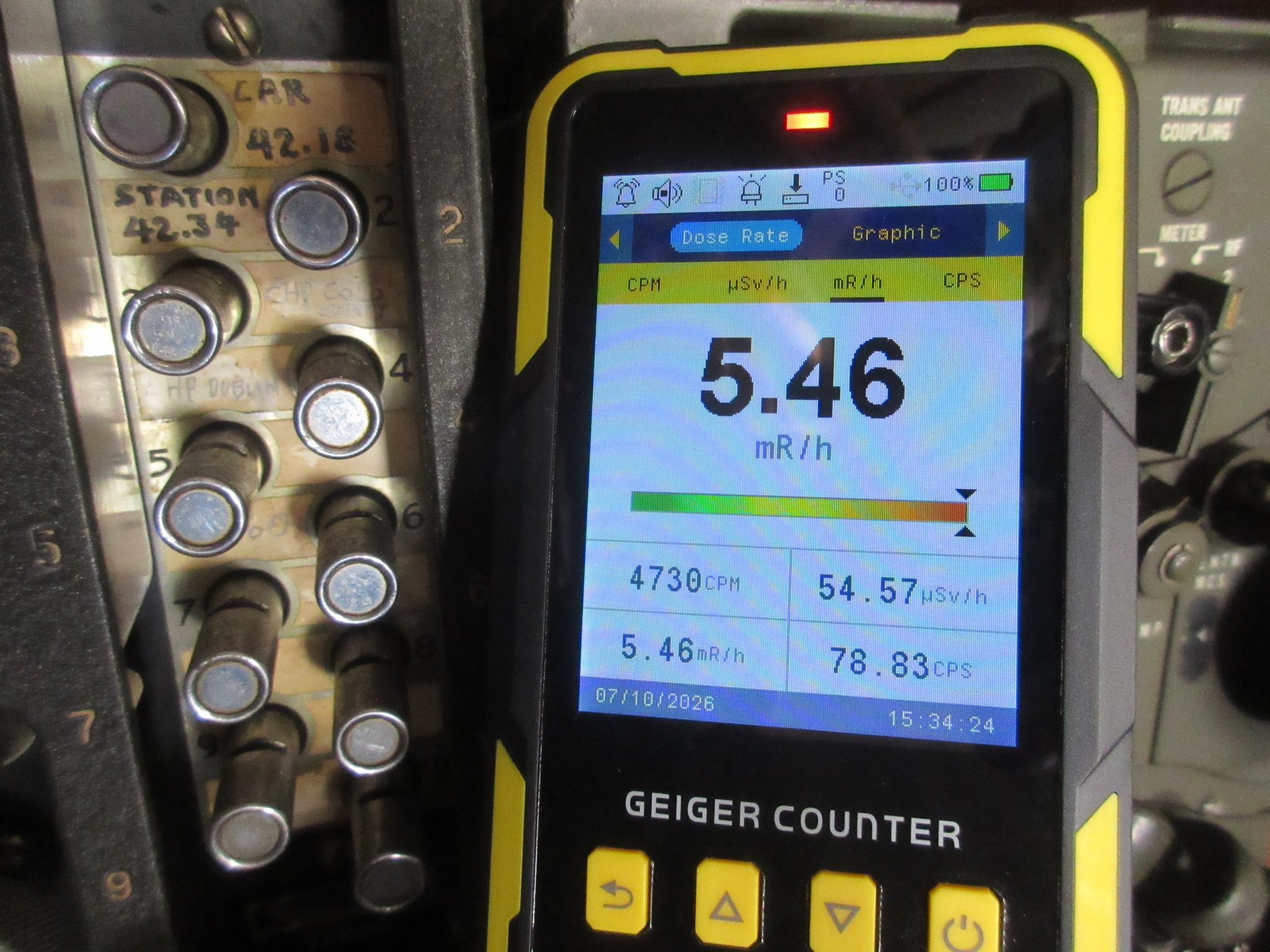
When additional sealant is applied it is safe to be around but keep your distance as a precaution. Do Not set it up on the night stand next to your bed!
Radium 226 is primarily an alpha and gamma ray emitter and it stays “hot” for a long time with a half life of 1600 years. It decays into radon gas, Rn 222 which has a half life of about 3.8 days. The radium emission finally damages the phosphor paint it was intended to excite in these old meters/radios. Very, very dim glow these days; the glow is gone but the radium is still there. Like a radioactive home smoke detector, these things are not very dangerous if left intact. Don’t disassemble it…
These measurements are primarily from 186 keV gamma radiation – alpha’s won’t penetrate the meter glass, nor will most beta’s; sorry, no neutrons. The GQ GMC-800 cannot detect alpha radiation because they couldn’t even penetrate the plastic instrument case to reach the internal geiger tube.
My R-390A Receiver meters also had detectable levels of radiation: The Carrier Level meter read 1.2 mR/hr, the Line meter read 0.4 mR/hr with an Eberline E120 Geiger counter at close range.
Here’s my RT-68 panel meter: About 7 times higher than my natural background.
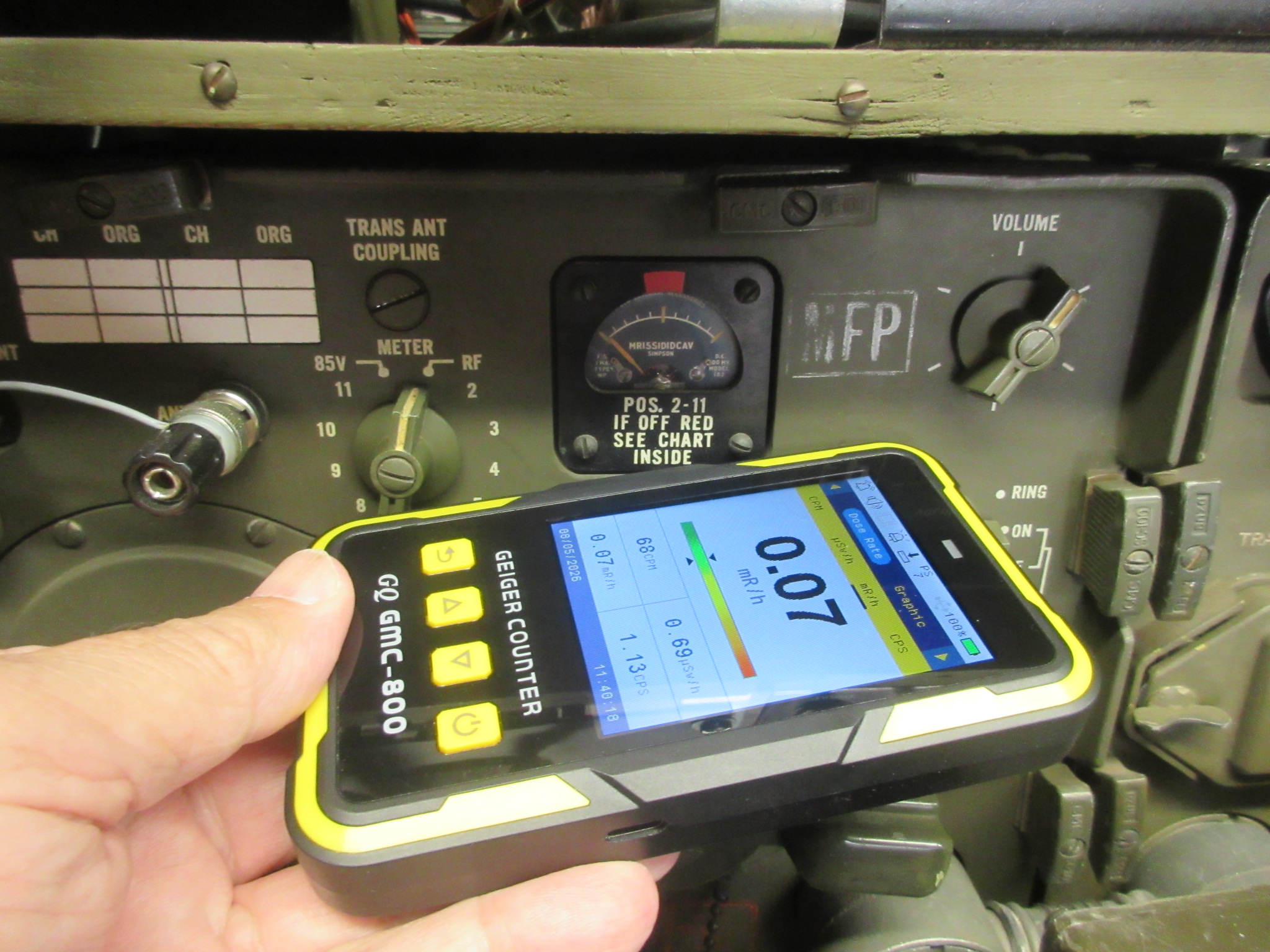
Here’s the reading from the meter on my BC-659 radio set: About 12 times higher than my normal background.
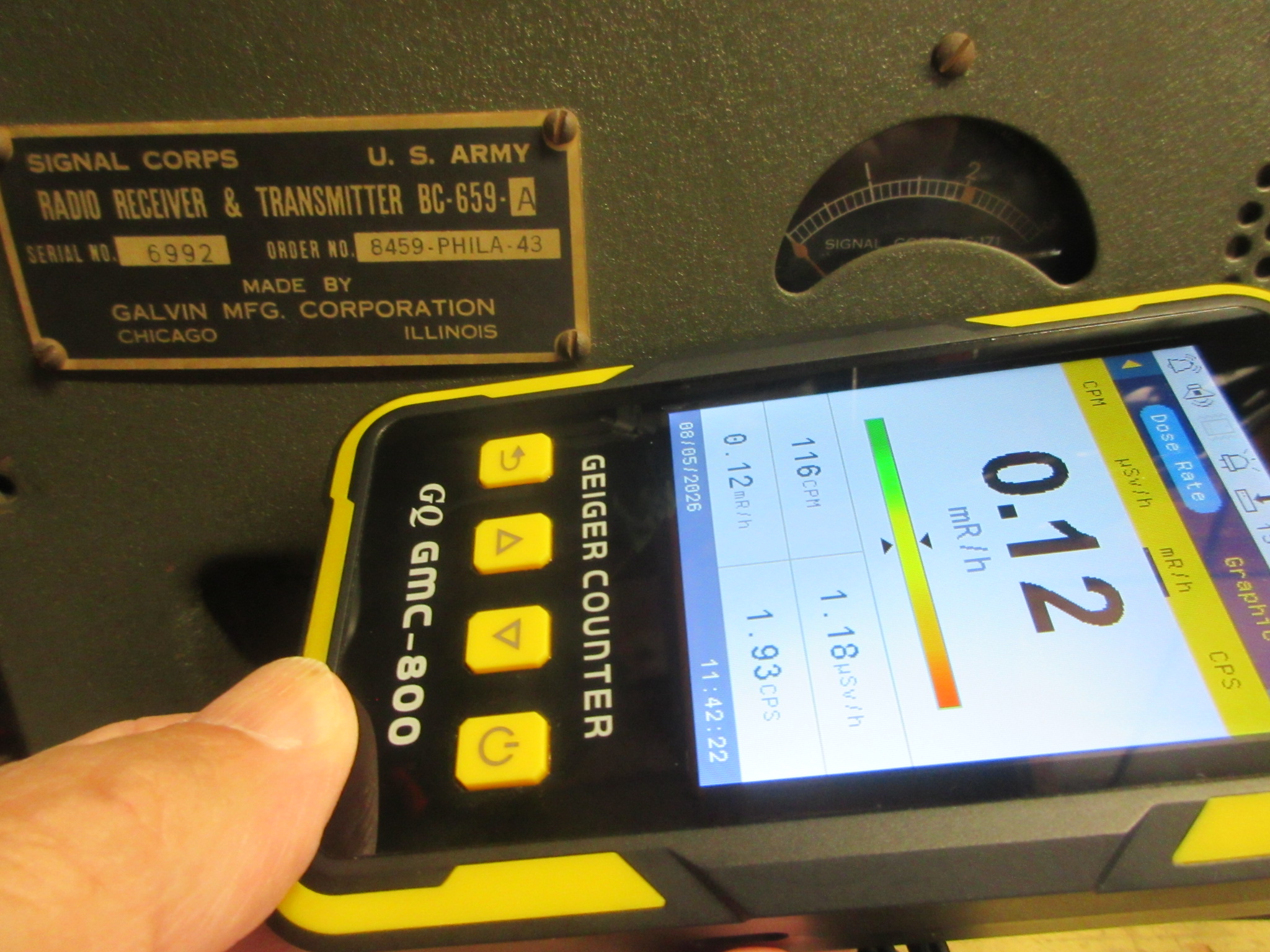
My TBY meter (below) read 0.77 mR/hr. Background radiation during these tests was 0.01 mR/hr.

Above: The unusual panel meter on the TBY 2 Receiver-Transmitter. A little radium paint on the “center” square and needle. Aim here. It measures 0.77 mR/hr at extremely close range, about 77 times above local background.
The TBY Transmitter and Receiver tuning dials look to me like radium paint but they show no detectable levels with the meter as close to them as I can get it. So the radiation seems to be solely from the meter dial and pointer. (The GM tube is directly underneath that black rectangle in this portable meter.)

Below is one of my 2 GRC-9 radios. Neither show any detectable radiation, the panel labels are phosphorescent or simple white paint. No radium paint used on my GRC-9’s – your mileage may vary.
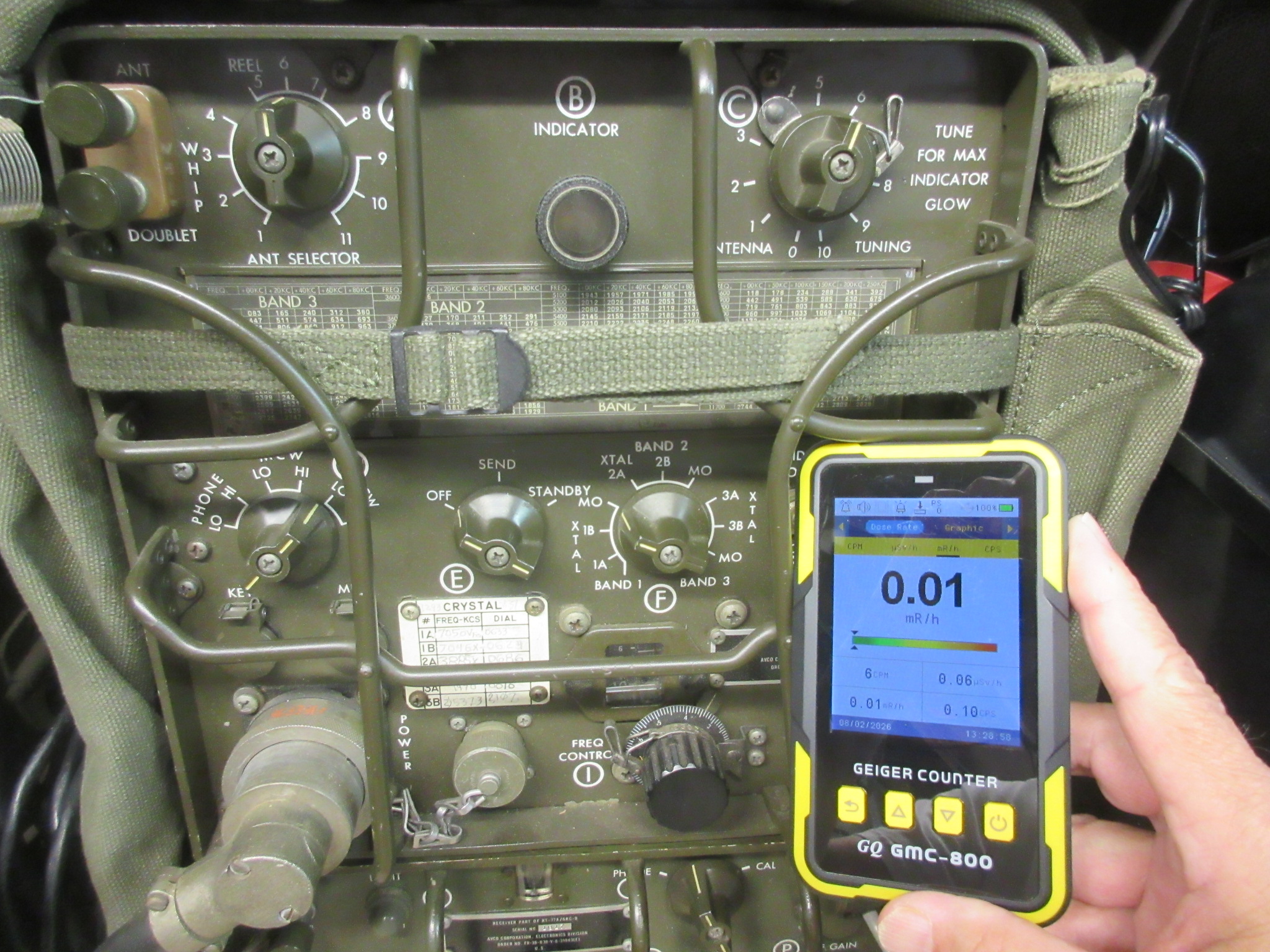
Here is the DC voltmeter in my truck dashboard, again at close range. About 80 cpm. (0.08 mR/hr) with Gammas.

Here is a WWII era small boat compass. It’s pretty hot. That enclosed binnacle is probably full of Radon gas, a radioactive decay product of Radium. Don’t open it!

On a related note: Military compasses and radiation.

The induction-damped Lensatic compass. In addition to general LandNav work, the Lensatic is especially good for taking Resection fixes (to locate your own position on a map relative to distant landmarks, a common task.) Or for identifying a distant “walk to” point along your intended route bearing.
Post WWII/Korean war era issued Lensatic types can use radioactive Tritium gas (AKA “3H”) which is a beta radiation emitter. It interacts with phosphor powder lining tiny glass vials to be self luminous (self excited) at night. The current performance specification, MIL-PRF-10436N does not require a radioactive source although the wording is somewhat ambiguous to provide the prospective vendor some design latitude. It is optional (Reference 75). If radioactive material is present the compass will be marked accordingly.
The waiver of a radioactive exitation feature was probably related to the non-availability of Tritium from U.S. production reactors in the 1980’s. They were our only domestic source of that hydrogen isotope before a new reactor(s) was built later on.
However Tritium has a half-life of 12 years so older “surplus” compasses on the market can be quite dim from their original brightness when manufactured. Caveat emptor.
My go-to compass, above, (NSN 6605-01-196-6971, Oct 1986 manufacture date) is an example with simple phosphorescent markings, chargeable with a flashlight for night Ops. Apparently Tritium was not always a requirement of that MIL Spec/NSN definition, at least in 1986.
Just as with explosives, and for the same reason, distance is your friend when dealing with sources. If you are VERY close, say by eating or inhaling the paint, you may have a serious health issue. Keep them sealed, do not disturb. Just be aware.
As an example of a WWII radio with radioactive paint take a look here: https://www.n6cc.com/bc-683-vhf-fm-artillery-receiver/
For further reading on this topic Reference 118 is excellent. It deals with the handling of radioactive aircraft instruments at the National Air and Space Museum.
Very interesting, Tim. Out of curiosity, have you ever examined Thoriated-Tungsten tube filaments with your Geiger counter? I’d be curious to know what levels they emit. DE N6MKC
Have not checked any of those tubes but Thorium 232 is also the radioactive material in the old lantern mantles – so it probably emits as well. The Alphas and most (all?) Betas would be blocked by the glass envelope if it’s not broken. The Gammas would get through. I tested an old OB2 voltage regulator tube which may contain an isotope to partially ionize the gas in the tube. Just observed background counts.