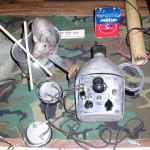
UPDATED 11/15/17 One recent project was building a replica of the “canteen radio” that was used by US Army personnel in the Japanese POW camp at Cabanatuan in the Philippines during WWII. Its layout follows a description and drawing published in Reference (5): US Army in WWII, The Technical Services, The Signal Corps: The Outcome pp 274-275; Below: (Please excuse the cut-n-paste job!)


With a “four-adjustments” design based upon the above drawing, the circuit design “falls out”; the original design becomes evident: Single tube regenerative receiver with regeneration control, a main tuning condenser, bandspread tune condenser and an antenna “condenser” capacitor. (Condenser is WWII lingo for a capacitor). Note that the Army sketch indicated the later use of a 6J7 tube with its’ inherent Grid Cap.
This replica that I built is very sensitive – using a 6SK7 or the 12SK7 as used in the original POW camp radio. It can receive many foreign shortwave broadcasts from about 3.8 – 7.9 MC, using a 50 foot wire antenna. Here is the schematic of my version; similar or identical circuits could be found in any 1930’s – 1940’s radio hobbyist magazines.

My replica radio will operate with B+ as low as 25 volts and up to 90 volts B+ but I usually run it at 63 VDC provided by seven, 9 V batteries. They simulate my 67.5 V dry cell that has failed long ago. (Note that B+ is on the headphone connections!) The POW camp captives also made batteries from bits of copper and zinc uniform buttons and sulphuric acid captured from enemy vehicle batteries. They had also captured dry cell batteries from the camp dispensary where they were “available”. Reference (12).
Here’s a look at the innards. The bamboo coil form is evident, the winding job is embarrassing.

The Signal Corps of WWII had many men who were “Ham” radio operators before the war. They were a key source for skilled Radio Men with their knowledge of electronics, radio technology and the all-important Morse Code skills. To them, the design of this type of radio would have been memorized long before – it was a basic, common design. No instructions needed by skilled personnel. Like mine, its construction was driven by the components actually available – and the knowledge needed to make suitable design compromises as a result.
This replica is made from primarily WWII vintage electronic parts and includes 2 interchangeable tuning coils wound on 1 inch diameter bamboo forms. One is for SW broadcasts, the other for MF broadcast band use; the turns are held somewhat in place with pine pitch. I have experimented with other coils for different frequency band coverage. It’s flexible.
The four D cell filament batteries are appropriately concealed inside a piece of bamboo tube. (Mine uses a 6SK7 because I couldn’t fit 8 D Cells inside the bamboo tube to power the 12 volt filaments of a 12SK7. Both tubes have otherwise identical performance and connections.) The 100 pf grid-leak capacitor is actually two 50 pf mica’s in parallel which I had on hand.
It is my first attempt at building a one-tube regenerative receiver and it works pretty well on AM and CW. Modern SSB reception (these days) is dependent upon very careful adjustment and your imagination – SSB stability isn’t great (it’s poor) but theirs brought in the AM news from BBC, Radio Australia and US west coast stations including KGEI in San Francisco quite well. Much more fun to play with than a modern “appliance” computer-with-antenna radio. Or reading Google News (GASP!) on the Internet…
Theirs was a “courage and ingenuity” type radio.

So, does it really work? Yes, surprisingly well on AM shortwave. It won’t compete with a BC-348, a Command Set receiver or even a “Radio Shack” portable shortwave radio (that’s not the idea) – but it works. Like all Regens, careful adjustment of the Regeneration control is important and all the controls interact with each other to a certain extent. The Regen control varies the screen voltage and therefore the gain. The tuned circuit is isolated from the antenna by a series variable “antenna” capacitor which reduced the detuning effect of the antenna on the tuned circuit. If the wind is blowing the antenna around or if you constantly have to reposition the antenna, the circuit detunes a bit and you have to compensate, but that is a very minor problem.
Selectivity is good, “tuning rate” via the screwdriver-mica compression trimmer “main tuning” is a bit coarse but the Chicken Head fine tuning knob makes that acceptable. Moving the feedback tap on the tuning coil makes it ” a completely different radio”, something that can only be appreciated while experimenting with the construction and testing.
The other coil wound on the bamboo form in the above photo can be substituted to receive the standard AM broadcast band if desired. In WWII Asia those stations were probably gone or under Japanese control, hence the POW’s used the radio for international Shortwave broadcasts. This radio performs well on the standard AM broadcast band with this larger tuning inductance coil.
On shortwave, I can clearly hear WWV in Colorado and Hawaii on 5 and 10 MC and occasionally CHU in Ottawa on 7850 KC. The big international SW stations come in pretty well after sunset. Considering the primitive nature of this radio, it does the job of providing outside contact as your imagination drifts back to a prison camp in the Philippines in WWII. The challenge for me was to see what kind of performance could be squeezed from some junk-box parts. Very satisfying project and a big hit with the public at displays and demonstrations.
There is speculation that the radio was actually originally built on Corregidor before its capture (and subsequent Bataan death march to Cabanatuan) but was later modified in the POW camp for a 6J7 tube after the original 12SK7 tube burned out as described above. The 12SK7 (VT-131) pentode tube would have been a logical choice at a forward Army base in WWII. That tube would have been available in quantity as it is used in the Army aircraft Command Set receivers and others during that time. It’s also obviously suitable in a single-tube radio design. Considering the parts requirements, the Corregidor assembly scenario rings true to me – but no firm record of that.
Its discovery at Lieutenant Gibson’s bunk would certainly have resulted in his summary murder, (not execution, Murder) at a minimum. But it escaped discovery by the Japanese guards until the camp was assaulted and liberated on 30 JAN, 1945. Assault personnel were from Company’s C and F, 6th Ranger Battalion, Alamo scouts and Filipino guerillas. The original radio apparently disappeared into The Fog of War at that time.
Using a radio like this in a POW camp also presents a “technical” discovery risk – the radio actually radiates a signal on the frequency to which it is tuned. That is inherent in a simple regenerative receiver circuit. If the POW camp had a shortwave communications receiver in their HQ (they likely did), any Japanese radio operator also listening to any of these radio stations would have heard the signal from the canteen radio on the same frequency. Any radio operator worthy of the name would immediately recognize it and realize that’s what they were hearing. VERY risky.
Reference (11) notes that there was a second shortwave radio at Cabanatuan, built by prisoners with parts stolen from the enemy radio repair shop where some US personnel were forced to work. They would capture the necessary parts from the enemy’s radio equipment they were supposed to be repairing, telling their captors that parts had failed and replacement parts were then needed. That radio was powered by the camp electrical lighting system which the prisoners had occasional access to. Brave, resourceful people.
As a telling fact, the United States GAVE radios to POW’s, at least to the Germans held in the US. We were not afraid of them finding out what was going on. The Escape Factory, Reference (6).
My reproduction canteen radio now resides in the Danville CA Veterans Memorial Building Museum. It utilizes a “captured” earpiece from a common telephone handset for an earphone. The radio is a popular addition to the museum WWII displays. The people who built and used the original had an important story to tell.

Al Klase, N3FRQ also built a replica that looks very similar to the sketch in the book. Nice job! Then also see Hiroki Kato’s (AH6CY) excellent articles in the Nov 2012, March 2013 and April 2013 editions of Electric Radio (Numbers 282, 286 and 287). Hiroki has built a fine reproduction and includes some of the historical background of the Cabanatuan camp operation. Do a web search on “Canteen Radio” – there are others around.
Below: An operating display at the Veterans Day 2017 Open House at the Veterans Memorial Building.

For this public display I used a hidden speaker/amp and an AC power supply to power the radio. I had a DVD player sending Glen Miller music into a nearby URM-25 signal generator which was transmitting the signal to the canteen radio. “WOW! It actually works!”
That signal also went to a BC-348 receiver in the museum to bring that display alive as well. Very popular.
For a few more detail photos look here: https://www.n6cc.com/n6cc-canteen-radio-details/
This site is WAY cool! I need a canteen radio!
All the more reason for hams to develop technical expertise.
You never know….
AMEN !
“Chance favors the prepared mind” Louis Pasteur
Surfin on eham and hit your link and checked out the “canteen radio” am in a hurry today, put your link in my favorites and i will be back! This stuff “all” really is cool and I’m shore will get lots of visitors. kf7dkl is my old tech. call, I’m now “w7kdh” and General class. anyway thanks for all your work!! and preservation of awesome parts of history. “73” ken
“
Thanks for visiting Ken, glad you found it interesting – it has been a fun project!
Tim
Hello, Tim —
The online magazine, Spectrum Monitor, has asked me to write a feature about foxhole radios. I will, of course, include a narrative of Hutchinson’s original from Cabanatuan, as well as N6CC’s replica of Hutchinson’s original. I have two questions for you: I am not a radio geek (more into naval history), and wonder if you would be willing to vet my draft manuscript for technical accuracy. I will also forward to Ken Reitz, editor of Spectrum Monitor, images of your replica and schematic of the canteen radio. What are your requirements for the images to be used in this online publication?
The feature on foxhole radios is not yet assigned. If you’re familiar with the magazine, you’ll enjoy my feature, “Commander Norden v. the Nazi U-boats” scheduled for August or September.
Hope to hear from you soon
J. Wandres
EML: jperiod180@gmail.com
Hi John – Sure – lets talk. Personal message sent.
I’ve built a hackneyed regenerative rig using a combination of circuits from the web. Aside from the solid state version I’ve made which runs with a ferrite loop and feedback coil which needs no longwire, I’ll comment on the tube version. I used only the “rf input circuit” of this configuration and connected it to one half of a 6SN7, a dual octal twin triode. One triode would be the RF tuner and detector and the second half an audio amplifier for “almost” computer speak volume or a preamp to an external audio amp. The “feedback” would be via the cathode with a pot in series to ground. A 2.5 rf choke or something close would have the RF plate B plus with a .01 cap out to a classic triode audio amp which can easily be found on the net. The coils can be done on the schematic specs and doubling the range or lowering the range would mean adding double the turns for double the range on hf to keep adding the same amount of turns so that you end up in the broadcast range.
A nice tool to have is an L/C or Uh meter to determine the frequency range of a coil. It could be an antique version for all it matters, for it works well. The coil can be scatter wound and not nice and proper when using air wound. Uh is Uh no matter how it’s wound. Only thing that matters is to have the coil unable to come loose by putting a layer of epoxy over it or a couple coats of liquid plastic on it after you have your range fixed. Cased in a metal case and well mounted caps would give rock solid operation. Mine turned out super sensitive on a 25 foot wire and cw and ssb was nice. I had room in the old Hallicrafters CB 3a cabinet to add a one tube 10 watt one crystal 40 meter cw transmitter. In 35 yrs of hamming,
I’ve collected 257 qsl cards internationally, 100 countries, and 47 from SWL’s back when the USSR hams needed qsls to get their ham ticket and other qsl ops. I’ve had the rig all this time and still pull it out in ANY propagation and still get at least one qso even if only a 400 mile hop. I know I wouldn’t get 5 bucks for it at a flea market, but to me actually – it’s a challenge, and being a new ham back then, I wanted to build something cheap to see if ham was for me other than CB. Sure enough, that first contact had me work hard on CW 20 wpm and theory to get the Canadian Advanced in one year, the highest one can get up here.
Hi Mike – thanks for checking in…You have illustrated the “Ham Spirit” for sure. Experiment, tinker, learn, have fun. To me, way more satisfying than pushing buttons on some plastic ricebox!
Thanks for visiting my website…
73, Tim
Would it be possible for you sir to build me one of these canteen radios to order? I will of course provide all the parts needed. And of course pay you for your time and effort.
Will there any radios like this built by the Vietnam POWs? Thank you
Hi Ernie…Unfortunately I would not be able to build one for you – my wife has other ideas regarding my “free time”! HaHa..
With the schematic and photos shown, a duplicate could be made using more modern components. I know of at least two others that followed the layout/schematic I posted. The original was built with even fewer resources…Take a look at Stefano’s comment below for example.
Regarding Vietnam era “foxhole” or DIY radios used by US/Allied POW’s, I kind of doubt it. But who knows. I’ve been to the “Hanoi Hilton” prison in “North” Vietnam so I doubt that anything like this would have been possible there, although our guys used the Tap Code to advantage among themselves.
Thanks for visiting my site – RLTW
Tim
Tim, I recently came across your photo of the replica canteen radio which would fit in perfectly with a video that I am working on currently, about the Bataan Death March. I was hoping that with your permission that we could use your photo in the film, with credit to you.
Thank you.
Hi Chris – Sure, OK to use it in your project… (I’d like to see the finished film if possible!).
Thanks for asking…It is an important story.
Tim
Tim-
My grandfather also built a radio in the bottom of his canteen in Cabanatuan…he was third in charge, Col. Arthur Lee Shreve, Executive on American Command.
On my web site you’ll see more as I published his diaries recovered from the camp- one of the best records of all. He was one of only 3% who survived- three hellships and the Death March.
He received 14 medals from the Philippine Campaign alone as he was Chief of Artillery on King’s staff.
My new novel about his amazing life and his internment comes out very soon!
This is good to see as I need to describe how its done in this novel!
Best- HP.
Hi Heather – Thanks for the note and thanks for documenting your grandfathers service and experiences in WWII.
It will be interesting to hear if he had documented anything else regarding the camp radios or their role in the overall events at Cabanatuan.
Thanks,,Tim
Has anyone ever built a solid state version before?
Hi Charles – I have not; but a single transistor regenerative receiver should be quite simple, probably many circuits on the Web. I would probably use an FET for one.
But then I guess it would not be the “same thing”..
Thanks for visiting my website!
It’s me……again!
Al Klase, N3FRQ, is a very good friend of mine. He got my last GRC-109. I’ve been to his place (before he moved) and saw that canteen radio first hand. Amazing! My only “clandestine” ops with a simple radio was when I was in the 8th grade and listened to the World Series on a little Xtal set next to the window in the class room. Got busted by my teacher, Don Dial, a WWII MP!
Vy73
Rich K7SZ
Hi Rich – Yep, Al did a very nice job on his reproduction radio. Hiroki also did a nice one – including a canteen transmitter! Not sure of its possible place in history but why not?
These are a good way to play with radios and learn some history along the way.
Thanks for stopping by! Tim
Found this page about a year ago, one weekend I put this circuit together on a board in about two hours time. Ant was about 6ft of wire, I listened to opera from Italy that evening, and then Havana Cuba after that. Great circuit worked first time out. Kf4tap
Hi Keith – Glad it worked! Pretty simple and not real fussy about component values. It was a fun project! Thanks for stopping by…
73, Tim
Buenas tardes me podrían indicar las vueltas de la bobina para onda media.Muchas gracias.
Sergio.
Hi Sergio…I don’t have access to the radio now (it’s in a museum). But I think the coil I made for Medium Wave frequencies was around 70 turns, probably tapped around 10-15 turns from ground. The bamboo form is about 4 cm in diameter, about 6 cm long. With a 345 pf tuning capacitor about 70 micro henries will bring it down into the MW bands. But please experiment! I think I even tried inserting small ferrite rods into it to see what it could tune to.
Thanks for visiting my website! Tim
—–
Hola Sergio … Ahora no tengo acceso a la radio (está en un museo). Pero creo que la bobina que hice para las frecuencias de onda media tenía alrededor de 70 vueltas, probablemente girada alrededor de 10-15 vueltas desde el suelo. La forma de bambú mide unos 4 cm de diámetro y unos 6 cm de largo. Con un condensador de sintonización de 345 pf, aproximadamente 70 microhenries lo reducirán a las bandas de MW. ¡Pero por favor experimenta! Creo que incluso intenté insertar pequeñas varillas de ferrita para ver qué podía sintonizar.
¡Gracias por visitar mi sitio web! Tim
Muchas gracias por contestar,muy amable.Voy a experimentar.Abrazo grande y lo felicito por la radio y la publicación.
LW6EAE.
Félicitations de notre part!
Nous avons commémoré le Centenaire de la Grande Guerre de 1914 à 1924.
Vous trouverez sur le site ref55.ddns.net notre historique de 1914 à 1918, le reste est mettre en place . aussi en construction
Bonne journée.
J C du REF55
Salut JC ! Merci de votre visite et du gentil message à l’occasion de la commémoration de la fin de la Première Guerre mondiale. Que la paix règne.
À bientôt, Tim